Phantoms and the proxy
An agent never holds a credential. It holds a phantom, a placeholder such
as __sprott__github__, and puts it exactly where the credential would go.
A proxy on your machine swaps in the real value as the request leaves.
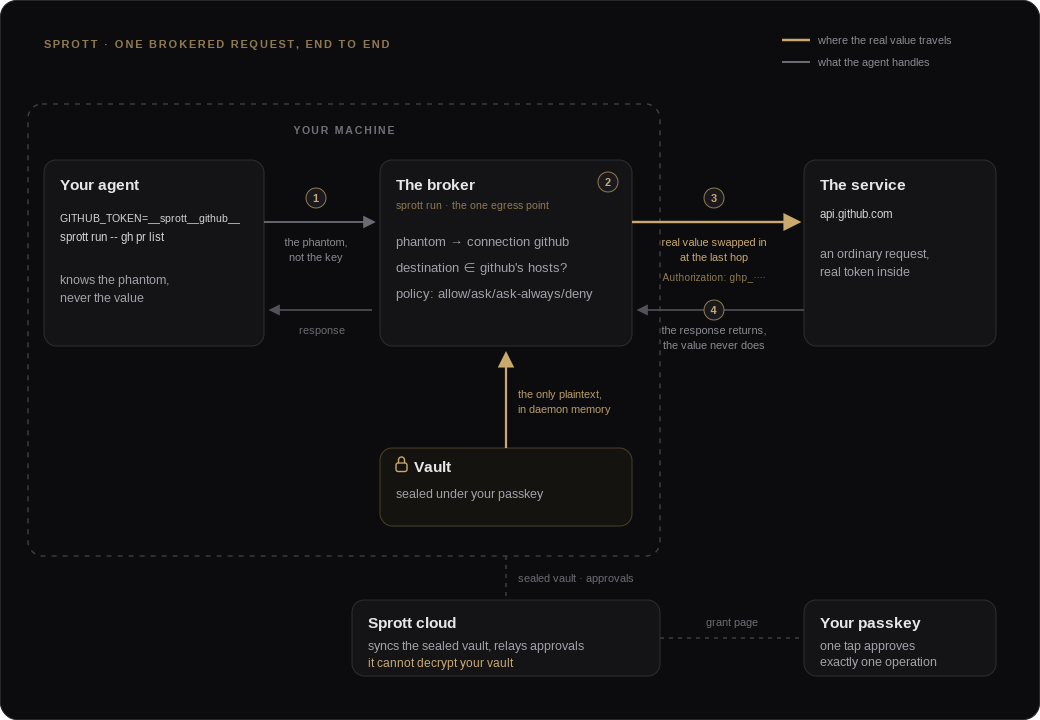
The phantom
Every connection has a phantom: __sprott__<connection>__,
or __sprott__<connection>__<key>__ when the connection holds several
values. The phantom works in any position the credential would: an env var,
a header, a query parameter, a request body, a URL path, or inside
Authorization: Basic. It never works in the host name.
A phantom is worthless anywhere except the proxy. Sent anywhere else, it reaches the service as a literal string and fails with a 401.
The broker
The broker is a daemon on your machine. sprott run -- <cmd> starts the
command with its HTTPS traffic going through the broker's proxy. Every
brokered request answers three questions, each with one owner:
| Question | Owner | Carried by |
|---|---|---|
| Where does the credential go? | the agent | the phantom's position in the request |
| Which value? | the vault | phantom, then connection, then secret (or the OAuth token it manages) |
| Is it allowed? | the vault | the agent's identity, the connection's hosts and policy |
The agent controls placement and nothing else. There is no call that returns a value and no endpoint that rewrites URLs. Every use of a credential is a request with a phantom in it, routed through the proxy.
The phantom is the only trigger
Inside a sprott run command:
- a request carrying a phantom is checked and, if allowed, gets the real value at the last hop;
- a request with no phantom is forwarded untouched.
Traffic outside sprott run is not touched at all. Sprott is not a
machine-wide interceptor.
What the broker checks
Before it swaps a value in, the broker checks:
- The agent. Each tunnel the command opens through the proxy carries a fresh proof signed with the agent's identity key. The agent must be admitted to your account and allowed on the vault (Identity).
- The destination. The host must be one of the connection's own hosts. Private and cloud-metadata addresses are refused for every connection.
- Policy. The connection's rules and floors decide
allow,ask,ask-alwaysordeny(Policy and approvals).
The value is added inside the proxy, after these checks, on the way to that host. The response streams back to the command. The value does not, and nothing between the agent and the proxy ever sees it.
Runs where your agents run
Each machine runs its own broker. It reaches whatever that machine reaches, including private networks and internal APIs. Your traffic and plaintext values never pass through Sprott's cloud. The cloud syncs the sealed vault and relays approvals.
Failing loudly
A request that can't proceed says so in the command's own output, with a
stable Sprott: <code> line: vault locked, approval needed (with the link),
host not on the connection, store unreachable. Each code and its fix is in
Error codes.
How to use this day to day: Use a credential.